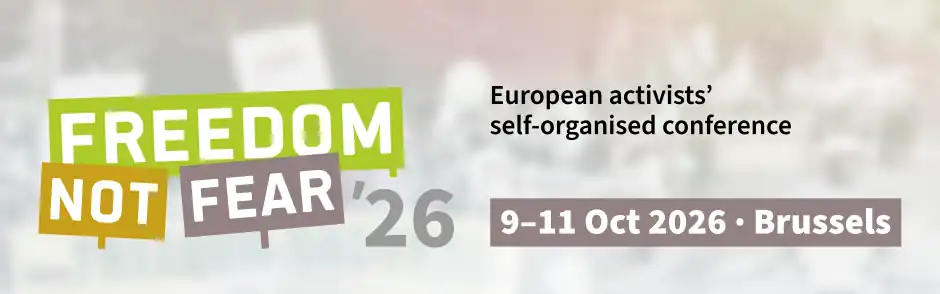
From 9 to 11 October 2026, Freedom not Fear, a self-organised conference on privacy and digital rights, will take place in Brussels.
People from all across Europe meet to work towards more freedom in the digitalised world, to plan actions against increasing surveillance and to promote stronger civil rights.
Do you have a question that is not answered here? Please contact us and let us know.
Table of Contents
1 Locations
- 9–11 October Conference venue: JES Brussels (Werkhuizenstraat 3, 1080 Sint-Jans-Molenbeek (OpenStreetMap)
- 12 October European Parliament (EP): 60 rue Wiertz / Wiertzstraat 60, Brussels (OpenStreetMap)
2 Participation – How can I register?
The FNF (un)conference runs from Friday in the evening to Sunday in the late afternoon. FNF is open for everyone. You can find the call for registrations here:
https://freedomnotfear.org/2026/call-for-registrations-fnf26
You can join as long as there are places available even without a registration. By registering you help our volunteer organising team plan, secure your spot and make sure you receive all the relevant information. Thank you!
3 Costs for Conference & Food
There is no registration fee, but we do ask for voluntary donations to cover expenses such as catering. During the event we will ask for donations for lunches and networking dinner(s) as well as donations to support organisational expenses.
Please bring cash!
You can also donate by bank transfer already:
https://freedomnotfear.org/2026/call-for-donations-fnf26
4 Travel, reimbursement and accommodation
We encourage travelling by train rather than plane.
For planning your journey, here are some approximate times to guide you: The conference will probably start at ca. 18:00 on Friday, so try to arrive in the hour before for welcoming and socialising. On Sunday the programme will wrap up in the late the afternoon at ca 18:00.
We encourage participants to schedule meetings with policy-makers, such as Members of the European Parliament (MEPs).
We try to offer financial support for travel costs to those who wouldn’t be able to (completely) cover their travel expenses themselves. Make sure to always keep receipts and tickets.
Costs for accommodation cannot be reimbursed. We generally ask participants to make their own arrangements. We do encourage couchsurfing and try to facilitate contacts among participants who can offer or seek a place to stay. Additionally, we have secured a limited supply of free beds in shared dormitories at the conference site for participants. You can reserve a spot in the registration form.
5 Catering / Food
FNF kicks off with a community dinner on Friday where we get to know each other while preparing a meal at JES Brussels. Our volunteer organisers book simple catered lunches on Saturday and Sunday and a dinner on Saturday evening.
You can help us plan this by indicating your interest and dietary requirements during registration.
6 Visit to the European Parliament
Note for returning FNF participants: This year there is no sponsored EP visit scheduled. However, we still explore options to organise a visit to the European Parliament with one or multiple MEPs for participants that are interested on the Monday following the official conference. Registered participants will receive more information as soon as we have it.
7 Self-organised MEP & policy-maker meetings
The European Union is changing. We feel it is more important than ever to share our ideas and concerns, to network and to develop strategies for digital rights advocacy. We strongly encourage FNF participants to reach out to EU policy-makers well before the conference and to schedule personal meetings with them in Brussels (many should be in Brussels on the Monday after the conference programme has ended).
You can use these meetings with policy-makers to discuss topics and issues that were brought up at FNF. Two years ago, we prepared a guide to help you with that. If you’re unsure where to start or want to connect with others, contact us without hesitation.
You can help others in getting in touch with policy makers? Please consider offering a session, preparing MEP meetings together during the weekend and taking other participants along with you!
8 Schedule
The rough schedule is:
- Friday, 9 October, from 16:00: registration | 18:00: opening, followed by community dinner
- Saturday 10 October, 9:30: keynote and opening plenary | all day: your sessions
- Saturday evening: networking dinner
- Sunday 11 October plenary in the morning | all day: your sessions
- Monday, 12 October: self-organised advocacy meetings with policy-makers
9 Programme
FNF follows a barcamp format where the programme is created by participants’ contributions during the weekend. Collaborative session planning will take place on Saturday morning, and some of the best sessions often emerge spontaneously from conversations on Friday evening.
There will also be time reserved on Saturday evening and Sunday morning for activities that bring fun and care to our event! Feel free to suggest meditation, yoga, games, a creative activity or to share a skill or hobby that helps participants relax and connect.
10 Language
The main language for communication and workshops at FNF26 will be English.
We cannot provide facilities for translation/interpretation. If you organise a session and find that it will be more appropriate to hold it in another language, please check with the participants that they are okay with that or provide some help for taking part in English.
11 Code of Conduct
We want everyone at Freedom Not Fear 2026 to be as safe and empowered to participate as possible. At the event we ask everyone to be conscious of your own behaviour and respect needs for distance or other safety measures of people around you. There is a code of conduct for FNF26 and we ask everyone participating and co-organising to read the code of conduct beforehand. We consider participation in Freedom of Fear 2026 as acknowledgement of the FNF26 code of conduct.
12 Photo policy
There is a strict no-photo policy, unless everyone in the picture has given explicit consent to it beforehand.
13 What to pack
Starting to pack? In addition to your usual packing for travelling (clothing, toiletries, medication, laptop or stationary…) your bag for FNF might include
- Stickers and flyers about your organization, ongoing projects, or campaigns.
- Books or documentation you’d like to share during the weekend. (Don’t forget to label them with a sticker indicating they should not be taken, and include your name to make sure to get them back)
- Masks and COVID-19 test kits.
- Power adapter for Belgium sockets (Belgium uses plug types C and E and socket type E. Voltage: 230 V, Frequency: 50 Hz) International travellers may need a type C/E plug adaptor.
- Any material to animated a session or facilitate an activity during the week-end (these might include playlists, games…)
- Your energy and any seeds of ideas for the sessions
14 Stay informed
To stay informed about FNF-related developments and meet other participants & friends, sign up to the mailing list.
Historically Freedom not Fear was founded by people from the German working group against data rention (AKVorrat) in 2006. The title “Freedom not Fear” is used by AKVorrat and like-minded groups for a series of activities related to human rights internationally. There have been events of all kind supporting human rights called “Freedom not Fear” from South America, the United States, Canada and all over Europe. The Brussels Freedom not Fear started as one activity out of many around the globe. During the first Brussels Freedom not Fear in 2011, it was decided to use “AKV-international” as the official mailing list for FNF instead of starting a new mailing list. Today this list is exclusively used by Freedom not Fear.
15 Donations
Since FNF has no official organisational structure, we need to collect donations via some other legal entity. This year, the non-profit association Digitale Gesellschaft from Germany is providing an account for donations – our heartfelt thanks for that!
More information on how to donate.
16 How is FNF organised?
Freedom not Fear is organised by a group of committed volunteers who prepare throughout the year. The event itself then is largely self-organised by participants.
The organising team is newly set up every year. Looking for an adequate venue and accommodation, contacting MEPs and dealing with a lot of EP administration and communication is part of the tasks as well as calculating a budget, looking for donations and funding, writing texts, setting up forms, advertising the event and communicating with participants.
Interested to join the organising team? Great! [Check our call for co-organisers]https://freedomnotfear.org/2026/call-for-co-organisers-for-fnf26) and don’t hesitate to contact us.
This year the event is organised purely by volunteers and with the help of German-based non-profit association Digitale Gesellschaft. We often receive further support by other digital rights NGOs and will make this transparent.